The largest district in the ACT
ACT Planning's Belconnen district profile gives Belconnen a population of 98,740 in 2017, the largest of the ACT's districts, with a projection of 128,000 by 2041. The median age in the 2016 census was 34. Those are the numbers that matter to a scaffold booking, because they tell you how many buildings, how many owners and how many trades are working in one area at once. We do not have figures for the work being done in the district.
This page is about what is specific to Belconnen: a district where most homes are low density, but where a substantial share are not, so that the same enquiry can lead to very different scaffolds. For the general case, the hire page explains how weekly hire works, and the erection and dismantling page covers who may put a scaffold up.
What the dwelling mix means
The district profile splits Belconnen's dwellings by density. Low density makes up 71 per cent, medium density 17 per cent and higher density 12 per cent. The dwelling mix in the profile is undated, so treat it as the shape of the district rather than a count. The shape is still useful, because each band tends to call for a different kind of scaffold job.
| Dwelling band | Share of Belconnen | What the scaffold job might involve |
|---|---|---|
| Low density | 71 per cent | Houses, which may be one or two storeys. Scaffold along the walls and possibly edge protection at the roof edge. The 4 metre line depends on the job. |
| Medium density | 17 per cent | Townhouses and small groups of dwellings. There may be several owners, shared access and a body corporate to ask first. |
| Higher density | 12 per cent | Apartment buildings. Taller structures are more likely, which can mean a licensed erector, a plan and a hoist or covered walkway. |
Read across the table and one point stands out: nearly three in ten dwellings in the district are medium or higher density, so some Belconnen jobs will involve more than one party. If you live in a townhouse complex or an apartment building, the first step may be a message to the body corporate or building manager, not a call to the scaffolder.
Houses: the 4 metre question
For the 71 per cent of Belconnen homes that are low density, the first question is how high the work is. In the ACT, erecting, altering or dismantling a scaffold from which a person or object could fall more than 4 metres needs a high risk work licence. WorkSafe ACT's scaffolding page says that scaffolding over 4 metres must be put up, altered and taken down by a competent and appropriately licensed person. Safe Work Australia's guide gives a small frame scaffold for repairing eaves or painting a ceiling as an example of work where the fall is 4 metres or less and a licence is not required. A single storey eave may be under the line and a wall of a two storey house may not be, but the scaffolder measures the fall and decides.
The line is not a promise of safety below it. A scaffold under 4 metres still needs guardrails, mid-rails and toe boards on working decks, trained people and a plan for the trades using it, and Safe Work Australia's tower sheet notes that a scaffold under 4 metres can still need a licensed scaffolder where there is another fall hazard, such as beside an excavation. Ask the scaffolder for the licence number of whoever will build it and check it with the issuing authority, since most local scaffolders do not publish licence numbers.
Townhouses, apartments and the bigger jobs
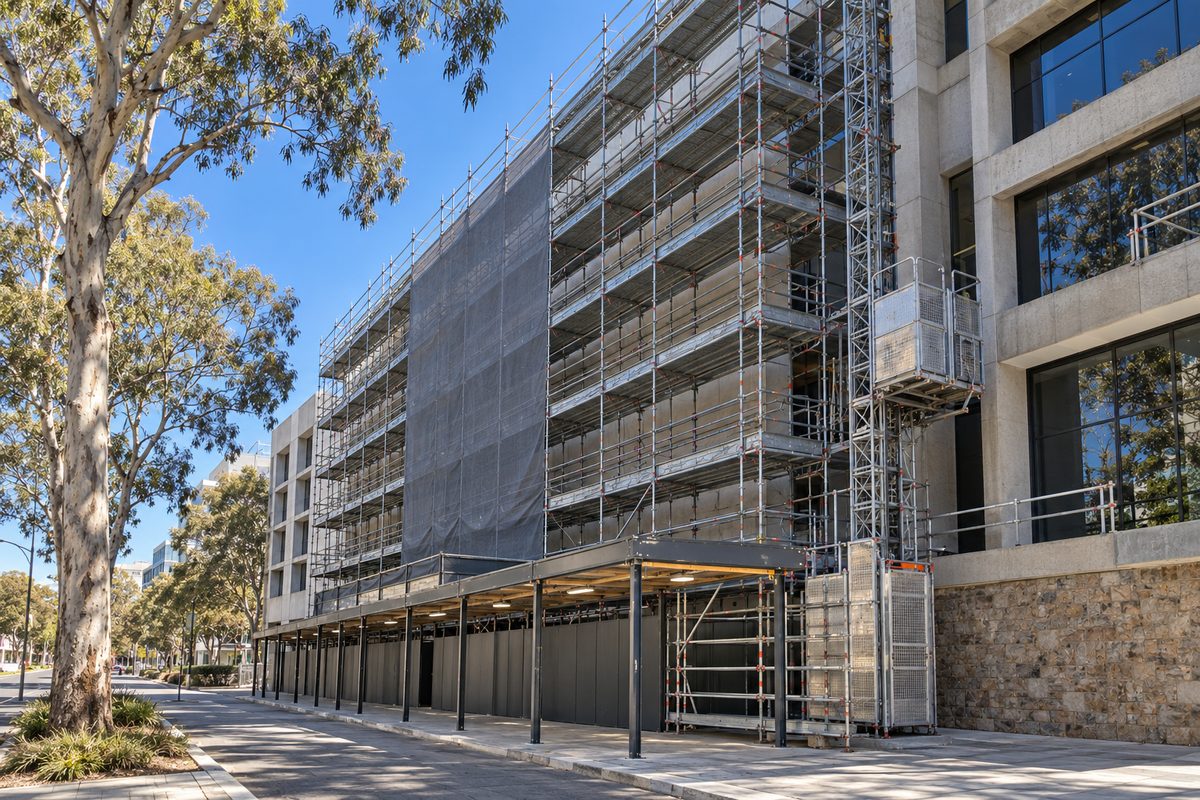
For the medium and higher density share, expect a different conversation. A scaffold on an apartment building is usually a larger structure, built higher, over more bays, with more people on it and more people beneath it. It often raises the questions in the commercial scaffolding page: a hoist for materials, a covered walkway over the footpath, a plan prepared by a competent person and a documented handover inspection. Safe Work Australia's guidance is that for more complex scaffolds a plan should be prepared and kept at the workplace, and it gives an example handover certificate that you can ask to see.
Where the project is large enough, the principal contractor's duties also apply. WorkSafe ACT says the Work Health and Safety Act gives duties to designers, scaffolding contractors, workers and principal contractors on construction projects costing $250,000 or more. If you are a building manager rather than a builder, find out who holds that role for the work and make sure the scaffolder's paperwork goes to them. Also remember that trades working on or near a scaffold need a safe work method statement, which is one more document to coordinate when several trades share one structure.
Growth to 2041
The projection from 98,740 to 128,000 by 2041 is growth of about thirty thousand people. We do not have verified counts of new builds or apartment pipelines for the district, so we do not claim any, and Region Canberra's building approvals report cited for the ACT as a whole gives no split between houses and apartments. If you have a fixed date, such as a builder arriving or a roof going on before winter, book early and ask the scaffolder about availability.
If your scaffold is for a painter and a roofer who both need it, say so when you ask for a quote, because the two will want different parts of the structure at different times, and the hire period depends on it. The hire length guide explains why.
Footpaths, nature strips and overhead lines
A scaffold on a Belconnen street may need approval if it sits on public land. The ACT process we found is the Public Unleased Land Act 2013, administered by Transport Canberra and City Services through the Public Land Use Team (02 6205 8794, CED.publiclanduse@act.gov.au). The ABLIS entry for approval for works on public unleased land says to apply fourteen working days before starting and notes that a temporary traffic management plan may be needed. No ACT page we found names scaffolding or hoardings, so the careful wording is that scaffolding or materials on a nature strip or footpath is likely to need approval, and you should confirm with the Public Land Use Team. We do not state any ACT hoarding standard or fee. The footpath guide goes through it.
Overhead lines are the other street-level issue. Evoenergy's scaffolding near overhead powerlines guidance gives 4 metres as the approach distance for metallic scaffold near overhead lines and says to contact Evoenergy before work starts if that cannot be kept. Inside that distance the erector must be Evoenergy-accredited. Treat any overhead line as energised and ask the scaffolder what they saw when they looked at your boundary.
Winter in Belconnen
We have no Belconnen-specific weather record, so we use the Canberra Airport figures from the Bureau of Meteorology: a mean minimum of 0.1 degrees Celsius in July and a mean maximum of 12.9. Frost and short days slow the trades on a scaffold, which may mean an extra week of hire. If you are planning a re-roof for winter, ask what the scaffolder's terms say about a week lost to weather, and allow time for it.
Booking a scaffold in Belconnen
Send the street or suburb, the height of the work, the use (painting, roofing, facade repair), whether the building is a house, townhouse or apartment, and any known constraint such as a nature strip, an overhead line or a body corporate. A photo from the street is a good start. Local scaffolders are concentrated in Hume, Fyshwick and Queanbeyan, so a Belconnen job may be served from outside the district, and travel may appear on the quote. For houses specifically the residential page sets out the usual sequence.
What this page cannot tell you
It cannot tell you how many scaffolds are in use in Belconnen, what a local job will cost or how long a particular approval will take. The district figures describe population and dwelling shape, not the age of buildings, their condition or the work being done on them. It cannot say whether your building needs a licensed erector, because the 4 metre line depends on the job. It also cannot confirm that a scaffold on a footpath is approved, which only the Public Land Use Team can do. Ask the scaffolder and the regulators for the current rules.
Check the current rules before you rely on this
This page describes the Belconnen district, its mix of dwellings and the licensing, public land and power line rules that apply to scaffolding there. It describes the rules in general terms as they stood in October 2026. Standards, forms, thresholds and fines change.
The authoritative sources are ACT Planning, Belconnen district profile, WorkSafe ACT, scaffolding, Safe Work Australia, guide to scaffolds and scaffolding work, Safe Work Australia, tower and mobile scaffolds information sheet, ABLIS, approval for works on or using public unleased land (ACT) and Evoenergy, scaffolding near overhead powerlines. Where anything here differs from those sources, they are right and we are not.
We are not scaffolders, engineers, regulators or lawyers. For what applies to your job, ask the scaffolding contractor, WorkSafe ACT (13 22 81) or, for work on public land, the ACT Government Public Land Use Team.
Accurate at the time of writing, October 2026. Always check the source before relying on it.