The short version
Queanbeyan is in Queanbeyan-Palerang Regional Council, in New South Wales. A scaffolder based on either side can serve the other. The licence rule is the same: SafeWork NSW uses the same class names, Basic (SB), Intermediate (SI) and Advanced (SA), and the same 4 metre definition as the ACT. What changes is who regulates the work, SafeWork NSW on 13 10 50 in New South Wales and WorkSafe ACT on 13 22 81 in the ACT, and who approves the use of public land, the local council under NSW roads law rather than the ACT's Public Land Use Team. This page sets out the differences and the gaps.
One licence rule, two regulators
SafeWork NSW's scaffolding licences page describes scaffolding work as erecting, altering or dismantling a temporary structure supporting a platform from which a person or object could fall more than 4 metres from the platform or the structure. That matches the model definition used in the ACT. Both jurisdictions apply the national model work health and safety laws, and no technical difference in licence classes was found between them.
| Item | Canberra, ACT | Queanbeyan, NSW |
|---|---|---|
| Licence classes | Basic (SB), Intermediate (SI), Advanced (SA) | Basic (SB), Intermediate (SI), Advanced (SA) |
| The 4 metre line | A person or object could fall more than 4 metres from the platform or the structure | The same wording |
| Licence issuer | Access Canberra, 02 6207 8096 | SafeWork NSW, 13 10 50 |
| Safety regulator | WorkSafe ACT, 13 22 81 | SafeWork NSW, 13 10 50 |
| Public land and footpaths | Public Unleased Land process, Public Land Use Team | Roads Act 1993 section 138 consent, usually from the council |
| Council or agency | Transport Canberra and City Services | Queanbeyan-Palerang Regional Council |
The licence rule is the same on both sides. The differences are the regulator and the local land and permit authority, which is why a scaffolder who knows one side well can still need to make a different phone call on the other.
Is a licence from the other side recognised?
Yes, per both regulators. Access Canberra's licence page says a high risk work licence issued by another state or territory will be recognised in the ACT, and that a transfer gives an equivalent ACT licence if Access Canberra is satisfied. Cancelled, refused or disqualified licences are not eligible. A SafeWork NSW safety alert dated 5 August 2024 says valid interstate high risk work licences are recognised in NSW, and employers must see the licence before high risk work starts. Checks can be made through Service NSW or with the issuing authority.
Safe Work Australia's licences page puts it generally: your high risk work licence is generally valid across Australia, but check with the regulator where you will work. SafeWork NSW adds that the licence must be issued by the state or territory the holder usually lives in, that a permanent move requires a transfer, and that a licence can be transferred if it is current or within 12 months of expiry.
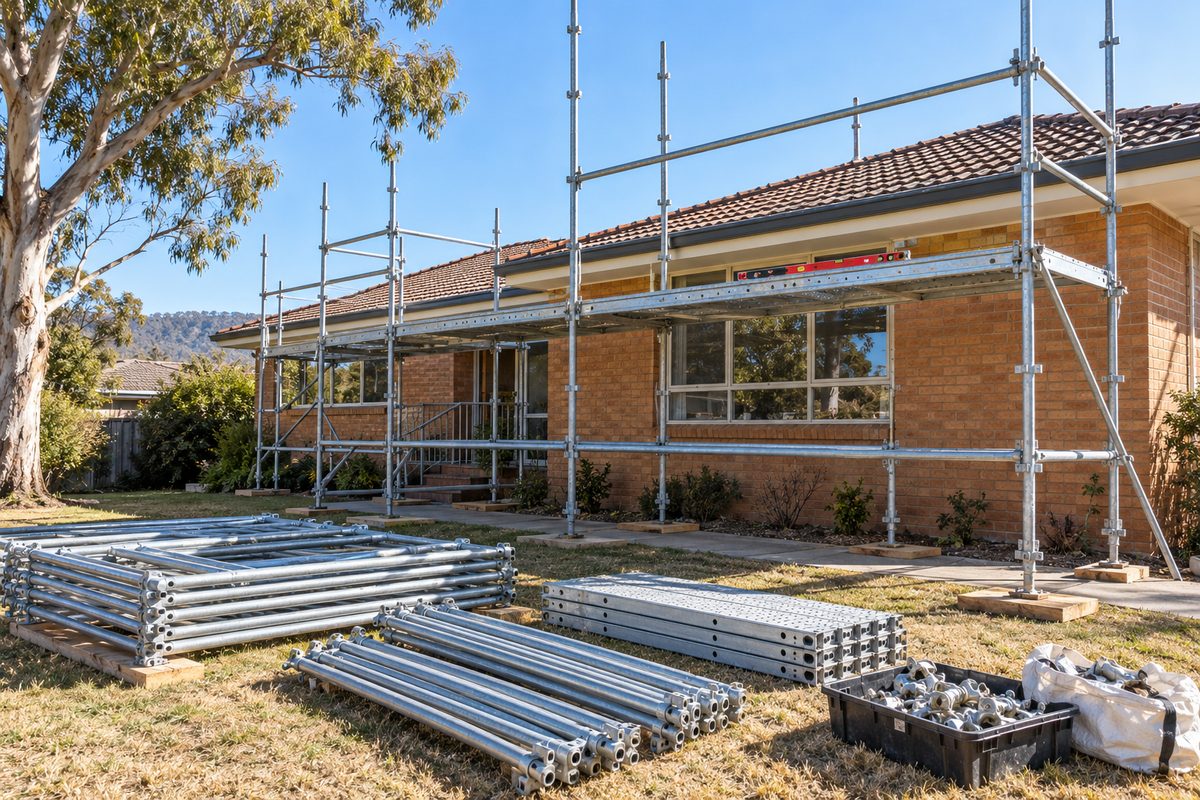
The plain consequence is that an ACT-licensed scaffolder can work in Queanbeyan, and a NSW-licensed one in Canberra, on the same class, per the regulators above. Local scaffolders are concentrated in the industrial areas of Hume, Fyshwick and Queanbeyan, and some serve both sides. Still ask the scaffolder for the licence number, the class and who issued it, because most do not publish them.
Roads, footpaths and nature strips in NSW
On the Queanbeyan side the public land question moves from the ACT process to the Roads Act 1993. The NSW Planning Portal's section 138 approvals page says consent under section 138 covers works on a footpath, nature strip or verge, and erecting, removing or interfering with a structure on a public road, with the local council usually the authority. Safe wording for a scaffold standing on the verge or footpath in Queanbeyan: it is likely to need section 138 consent, and the council confirms.
The gap is local. QPRC publishes an approval to swing or hoist an item on or near a public road, under the Local Government Act 1993, with contact council@qprc.nsw.gov.au and an office at 256 Crawford Street, Queanbeyan, according to the business approvals listing. The listing does not mention scaffolding or hoarding. QPRC's own scaffold or hoarding approval was not found for this page, so ask the council before you assume either that one exists or that one does not. The footpaths and nature strips page covers the ACT side.
The two places in numbers
The ABS 2021 Census quickstats for Queanbeyan-Palerang records 63,304 people, a median age of 38 and 26,503 private dwellings, with 73.9 per cent separate houses. For the ACT as a whole, the ABS snapshot records 454,000 usual residents in 2021, with separate houses at 63.2 per cent and flats or apartments at 19.4 per cent.
The difference people notice is paperwork, not carpentry. A Queanbeyan owner with a roofer from Fyshwick has a NSW regulator, a NSW council and an ACT-based scaffolder. A Canberra owner with a scaffolder from Queanbeyan has an ACT regulator and an ACT land authority, and a NSW-based business. Ask each of them early who is responsible for which step.
Who actually crosses the border
Both the ACT and NSW recognise interstate high risk work licences, and Safe Work Australia describes a licence as generally valid across Australia. What they ask for is that the licence is real, current and held by the person doing the work.
That matters for how you check a quote. A business with a Queanbeyan address may hold ACT licences, a business with a Fyshwick address may hold NSW ones, and either is allowed to work on your side of the border. The question to put is the same in both places: who is the licensed person, which class and which issuer, and will they be on site while the scaffold goes up. Because most local scaffolders do not publish licence numbers, expect to ask by phone or email and expect a quick answer from anyone who holds one.
What to ask when the scaffolder is from the other side
- The licence. The number, the class and which state or territory issued it. For an interstate licence, ask where the check was made.
- The regulator for the job. For a Queanbeyan site it is SafeWork NSW, for a Canberra site WorkSafe ACT.
- The verge. Whether any part of the scaffold, a walkway or a skip will be on public land, and who is asking the council or the Public Land Use Team.
- Overhead lines. In the ACT the network is Evoenergy's. On the NSW side, ask the scaffolder which network operator applies, because the Evoenergy figures in this site are for the ACT network.
- The handover. A tag, an inspection and a written confirmation that construction is complete, whichever side it is on.
What mutual recognition cannot do
Recognition of a licence cannot make an unlicensed person licensed, cannot cover a cancelled or refused licence and cannot tell you which class a job needs. It does not give approval for the verge or footpath, which belongs to the council in Queanbeyan and the Public Land Use Team in the ACT. It does not settle QPRC's own position on scaffolding or hoarding, which was not found. Check the licence with the issuing authority and the verge with the council. This site is a referral service and carries out no scaffold work.
Check the current rules before you rely on this
This page describes how scaffolding licensing and public road approvals differ between Canberra and Queanbeyan across the ACT and New South Wales border. It describes the rules in general terms as they stood in October 2026. Standards, forms, thresholds and fines change.
The authoritative sources are SafeWork NSW, scaffolding licences, SafeWork NSW, compliance visits to target unlicensed workers, Access Canberra, high risk work licences, Safe Work Australia, licences, NSW Planning Portal, section 138 approvals and ABLIS, approval to swing or hoist an item on or near a public road, Queanbeyan-Palerang. Where anything here differs from those sources, they are right and we are not.
We are not scaffolders, engineers, regulators or lawyers. For what applies to your job, ask the scaffolding contractor, WorkSafe ACT (13 22 81) or, for work on public land, the ACT Government Public Land Use Team.
Accurate at the time of writing, October 2026. Always check the source before relying on it.